
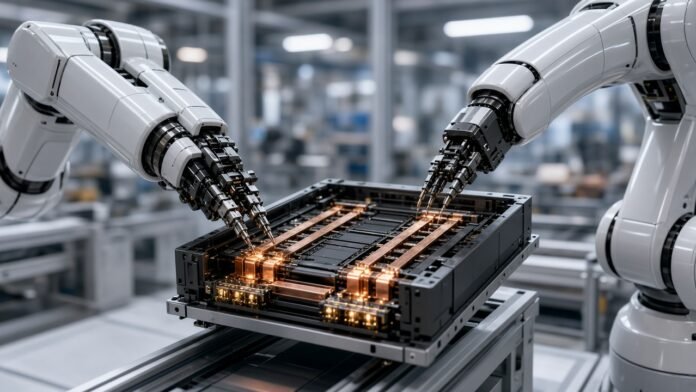
AI servers are usually discussed in chips and megawatts. The quieter bottleneck is whether robots can assemble them reliably enough for volume production.
Reporting on 5 October 2026 covered disclosures from Nvidia and Foxconn (Hon Hai) that robots assembling critical GB300 NVL72 tester-tray steps reached high success rates: above 95% on busbar assembly and 90–95% on multi-connector insertion. Coverage cites Nvidia’s 2 October technical blog, “The Machines that Make the Machines.” [1][2]
What the companies say they measured
Focus Taiwan (CNA) reported that Nvidia and Hon Hai trained robots for busbar work—16 screws—and multi-connector insertion on GB300 tester trays. Busbar success was put above 95% with a cycle-time target under 124 seconds; connectors at 90–95% with a 72-second target. [1]
TechTimes elaborates the same company-reported figures and notes a Houston deployment context. It explicitly flags the numbers as Nvidia’s own measurements, not a third-party line audit. [2]
“Yield” here means how often a robot completes a step successfully, not how fast the whole factory ships finished systems. Cycle time is the separate clock on how long each attempt takes.
Why a 95% figure still matters
Electronics manufacturing often aims much higher—TechTimes notes that 99.5% is a familiar electronics norm—so these rates are early, not finished. Even so, publicly quantified robot yields on GB300 assembly steps are a rare production datapoint for “physical AI” in AI-server manufacturing. [2]
TechTimes also notes that cycle time reportedly still sat above target—about 160 seconds versus the 124-second busbar goal—so throughput and yield are not the same story. [2]
What we don’t know
- Yields and cycle times are company-reported; no independent factory audit is cited in the secondary coverage.
- How these step-level rates translate into full rack or cluster output is not spelled out.
- The direct Nvidia blog URL was not retrieved in the research pass; Focus Taiwan and TechTimes are named secondary sources citing that company post.
The Bottom Line
Nvidia and Foxconn say robots are clearing roughly 90–95%+ success on two fiddly GB300 tester-tray steps—useful evidence that physical AI is moving into AI-server lines, and still short of the yields mature electronics plants expect. Treat the percentages as the companies’ scorecard until outsiders can inspect the lines.
Sources
- Focus Taiwan / CNA, 5 October 2026 — https://focustaiwan.tw/sci-tech/202610050008
- TechTimes, 5 October 2026 — https://www.techtimes.com/articles/328534/20261005/nvidia-robots-clear-95-assembly-yield-gb300-nvl72-first-quantified-production-data.htm

