French quantum computing company Pasqal says its 256-qubit neutral-atom processor has caught a simulated magnet behaving in a way theory did not predict. In a release on 27 October, Pasqal said that under certain conditions the system “takes far longer to settle after being disturbed than theory predicts”. The work is described in a preprint on arXiv, first posted on 7 August, that has not been peer-reviewed.
Pasqal says the result is not “a demonstrated computational quantum advantage”. The team also says it cannot yet explain the slowdown.
What the experiment did
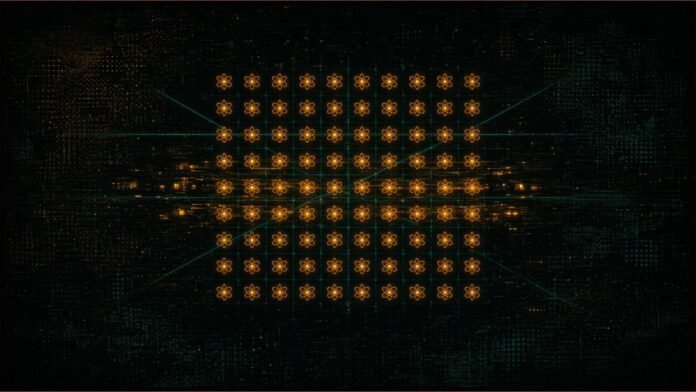
The team, which includes researchers from the Flatiron Institute, the University of Augsburg, Forschungszentrum Jülich, the University of Regensburg and the Institut d’Optique–CNRS, arranged 256 rubidium atoms in a 16 × 16 square grid. Each atom stood in for a tiny magnet, or spin. Lasers set the strength of a field acting on the spins, and the interactions between atoms coupled them together.
The researchers then changed the field suddenly, a move physicists call a quench, and watched how the grid settled. They repeated this at different field strengths.
According to Pasqal’s technical blog, three patterns appeared. When the field and the interactions were similar in strength, the system settled quickly, as expected. At a strong field, it stalled on a long-lived plateau and behaved like a different kind of magnet, known as an XY magnet. In between, it settled far more slowly. “The origin of this slowdown remains unresolved,” the blog says.
Where classical computers lose track
The slow regime is where ordinary computers struggle. The team ran three classical tensor-network simulations alongside the experiment. All three matched the processor at first, then drifted away from it, and from each other, as the system grew more complex. The preprint says this happens “precisely where state-of-the-art classical tensor-network methods lose control at late times, whereas the quantum simulation remains consistent across system sizes”.
To rule out errors in the machine, the team modelled its noise and checked smaller 5 × 5 grids with exact calculations. Pasqal says those ideal simulations show the same three patterns, so noise alone cannot explain them, although it does affect how fast the system appears to settle.
Loïc Henriet, Pasqal’s chief technology officer, said: “This is what makes quantum computing so exciting: we are not simply reproducing what we already know, but uncovering behavior we did not expect.” Joseph Tindall of the Flatiron Institute said comparing quantum devices with classical simulations “is much more beneficial than just trying to prove quantum advantage”.
A useful instrument, with limits
Pasqal’s framing here is careful, and that matters. Quantum companies often lead with speed claims. This one says plainly that “no computational-advantage claim is made” and that the study “does not compare runtimes or computational costs”. What it shows is narrower: a regime where three classical methods stop agreeing, while the quantum machine gives steady answers.
That is a real result, but steady is not the same as right. The processor’s answers stay consistent as the grid grows, yet there is no independent way to confirm them in that regime, which is the very reason the work is interesting. The paper has also not yet been through peer review, although it has been public as a preprint since August, which gives other groups the chance to test it.
The more convincing test will come from real materials. Pasqal says it has already used the same hardware to match measurements from a real magnetic crystal, and wants to compare future runs with lab data again. If a quantum machine can predict how a real magnet behaves where classical tools fail, that would be a stronger case for quantum simulation as a science tool. Other groups are pushing the hardware too, from faster qubit gates at Jülich to neutral-atom rival QuEra’s government research work, while classical simulation keeps improving, as NVIDIA’s 104-qubit run on JUPITER shows.
Next steps the team sets out
Pasqal says separating real physics from noise and size effects will need larger grids, longer runs and better classical calculations. Its stated aim is a theory that explains how the system moves between the three patterns.
Sources
- Pasqal: “Pasqal’s neutral-atom processor uncovers quantum magnet behavior that theory did not predict” (27 October 2026)
- arXiv: “Exploring the Relaxation Landscape of a 2D Quantum Magnet on a 256-Qubit Processor” (preprint, first posted 7 August 2026)
- Pasqal blog: “Unexpected relaxation in a 2D quantum magnet on a 256-qubit processor” (27 October 2026)
Related stories
- Jülich-Led Team Runs Qubit Gates in 6.8 ns, Calling It a Speed Record
- QuEra Scientists Named Co-PIs on Three ARPA-E QC3 Quantum Teams
- NVIDIA Simulates 104 Qubits on JUPITER to Test a Cheaper Quantum Error Fix
- Do AI Agents Need Elaborate Harnesses? A Minimal-Agent Study and Two New Toolkits
Follow @tsnmediahub on X for breaking AI news as it happens.
Follow on X