Sakana AI has published MASS (Multi-Agent Self-Supervision), a method for making an AI model improve itself, in an announcement dated 12 October 2026 [1]. The paper appeared on arXiv on 8 October [3].
CONFIRMED: Sakana released the method, paper and code. REPORTED: every result is Sakana’s own, in a preprint that has not been peer-reviewed. TSN has not tested it.
What MASS is
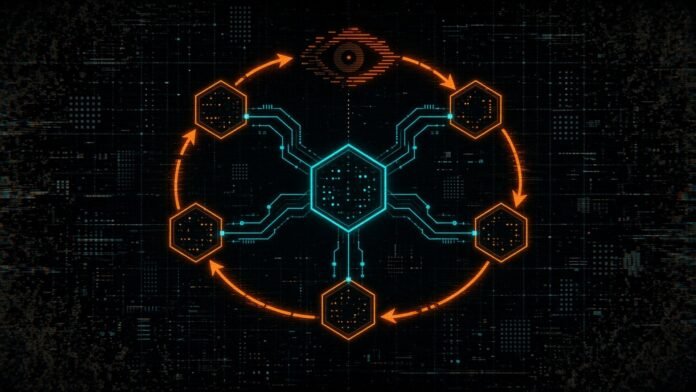
Sakana says: “We introduce Multi-Agent Self-Supervision (MASS). One shared model solves tasks through a team of virtual subagents, searches for better multi-agent workflows, then uses its own judgments to select the best ones.” [1] The model is then trained on the best team’s work.
This is an attempt at recursive self-improvement: a model that gets better, then uses its improved self to make the next round of improvements, and so on. Here the same model does the work, designs the team, and grades the results. No human marks its answers.
What Sakana reports
Sakana says: “We ran two cycles using a 27B open-weights model on synthetic open-ended research tasks. After the second cycle, score per output token reached 1.2-1.6x the base model’s level across four research benchmarks.” [1]
The base model was Alibaba’s Qwen3.6-27B, run inside the qwen-code agent tool; the paper names the Qwen3.6-27B-FP8 version [2][3].
Score per output token means how good the results are divided by how much text the model wrote to get there. A 1.5x figure means more quality for each word produced, which can come from better answers, shorter work, or both. It is not the same as “1.5 times better”.
The four benchmarks were MLR-Bench, DSBench, ScienceAgentBench and AstaBench [2]. On two coding tests the model got slightly worse by this measure: 0.96x the base on Terminal-Bench 2.0 and 0.94x on SWE-bench Verified. Sakana says “transfer remains uneven” [2].
To check progress from outside, Sakana asked GPT-5.5 and Claude Opus 4.8 to judge the work. On three synthetic test tasks, the model beat the base model 53.9% of the time after round one and 69.9% after round two; round two beat round one 60.8% of the time [2]. Sakana also says the model’s own judgments agreed with those outside judges more often over time, rising “from 73% to 93% across the three cycles” [2].
The risk Sakana names
Sakana warns: “When a model is also its own evaluator, shared blind spots could allow mistakes to be accepted as progress and reinforced through training.” [1]
What is released
The code is on GitHub, but it carries no open-source licence. Its notice says “No public open-source license has been assigned to the MASS-specific code”, and model weights are not included [4].
Sources
- “Recursive Self-Improvement through Collective Intelligence”, Sakana AI, 12 October 2026. https://sakana.ai/mass/
- MASS detailed blog, Sakana AI. https://pub.sakana.ai/mass/
- Hyunin Lee et al., “Recursive Self-Improvement through Multi-Agent Self-Supervision”, arXiv:2610.12176, submitted 8 October 2026 (preprint). https://arxiv.org/abs/2610.12176
- SakanaAI/mass repository, GitHub. https://github.com/SakanaAI/mass
Related stories
- ReSI Preprint: An Automated Safety Loop Cuts X-Teaming Attack Success From 86.01% to 31.45%, the Authors Report
- Claude Managed Agents Adds “Dynamic Workflows” in Beta
- Vercel’s eve Is an Open-Source Framework for Building AI Agents
- Nous Research Offers “MISSINGNO,” a Free Coding and Agentic Model, for a Limited Time