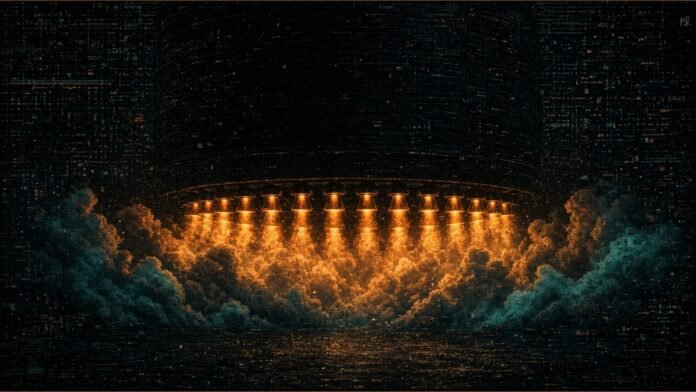
SpaceX has fired all 33 Raptor engines on the Super Heavy booster that will launch Starship’s 15th flight, one of the last big tests before the rocket flies. “Full duration 33-engine static fire for the Super Heavy booster preparing for Flight 15,” the company posted, via @SpaceX on X, at 19:49 GMT on Sunday 25 October, with two videos of the firing.
SpaceX has not set a launch date. Aviation planning data point to no earlier than 8 November, NASASpaceflight reported, according to Spaceflight News.
In brief
- SpaceX completed a full-duration static fire of all 33 engines on the Flight 15 Super Heavy booster on 25 October.
- No launch date has been set; aviation data reportedly point to 8 November at the earliest.
- Musk says Flight 15 will try to catch both the booster and the ship, and no Flight 15 licence has been announced.
Booster 22 on Pad 2
Observers watching live identified the vehicle as Booster 22 on Starbase’s Pad 2, with ignition at 13:22 GMT, Spaceflight News reported. The booster stayed clamped to the launch mount while its engines fired. It had rolled out to the pad on Saturday 24 October and was lifted onto the mount within hours.
The City of Starbase had closed Boca Chica Beach and State Highway 4 for the test. Mayor’s Order No. 2026-24, signed by Mayor Bobby Peden on 23 October, set Sunday as the main closure day and Monday 26 October as a backup. Elon Musk shared the test on X with the words “Starship Flight 15 static fire“.
Booster 22 is a third-generation, or V3, Super Heavy. According to Spaceflight News, the V3 design has three grid fins instead of four, each 50% larger; a built-in hot-staging section in place of the single-use ring of earlier boosters; and a redesigned fuel transfer tube that SpaceX says lets all 33 engines start at once. Each Raptor 3 produces 250 tonnes-force of thrust, up from 230, and weighs 1,525 kg, down from 1,630 kg, the outlet reported.
NASA says engine fixes arrive on Flight 15
NASA has its own stake, because Starship is also its Moon lander, and the agency has just changed both lander plans to speed up a 2028 crewed landing. At a briefing on 23 October, NASA’s Artemis programme manager Jeremy Parsons said SpaceX had found the root cause of several Raptor relight failures. SpaceX had made “several quick fixes for Flights 13 and 14”, he said, and “they already have permanent hardware improvements coming for Flight 15 when they start flying an improved version of the Raptor”, Spaceflight News reported. Parsons did not say which stage would carry the new engine.
Parsons also said NASA expects the flight probably in November, and that it could likely include a return to the launch site and a catch of both stages, the outlet reported.
The catch is Musk’s plan; the licence comes first
Flight 14 on 28 September was, in SpaceX’s words, the first orbital Starship flight, carrying 26 Starlink V3 satellites. One booster engine shut down early during the climb, SpaceX said, as TSN reported.
Flight 15 aims much higher. On SpaceX’s third-quarter results call, Musk said “we’re going to attempt to catch both the booster and the ship”, adding that it was “more likely than not” to succeed, as TSN reported from the call. President Gwynne Shotwell said SpaceX expects the FAA licence to include tower catches for both stages. That licence has not been announced, and the FAA’s Starship page listed no Flight 15 entry on Monday.
A ship catch would mean bringing the upper stage back from orbit, through re-entry, and into the tower’s arms. SpaceX has caught boosters before but never a ship. A static fire tests engines, not the ship’s heat shield or the tower’s timing, so Sunday’s result removes one booster risk and none of the catch risks. The dates so far are reported or Musk’s, not SpaceX’s.
Pad 2 still has to show it can turn around
The test was also another workout for Pad 2, the launch site built for V3. Spaceflight News says it has hosted every Starship launch since Flight 12 in May, with chopsticks driven by electromechanical actuators rather than hydraulics and a flame diverter meant to need no repair after launch. After the last two campaigns, launch came about two to four weeks after the booster’s static fire.
Stakes beyond the pad are rising too: SpaceX is pouring money into AI, with Musk claiming $40bn of debt closed for GPUs, and Starship is what carries the next Starlink satellites. The next marker is the FAA licence, and whether it allows a ship catch. For more, see TSN’s Musk Companies hub.
Sources
- SpaceX: Full duration 33-engine static fire post, X, 25 October 2026
- City of Starbase: Mayor’s Order No. 2026-24, beach and road closure, 23 October 2026; Beach and road access
- Elon Musk: Starship Flight 15 static fire, X, 25 October 2026
- Spaceflight News: SpaceX completes full-duration 33-engine static fire of Super Heavy Booster 22 ahead of Flight 15, 25 October 2026
Related stories
- SpaceX’s Latest: Dragon Delivers the Station’s Last New Solar Arrays, and Musk Says Starship Will Try Its First Ship Catch
- Musk Says SpaceX Has Closed $40bn of Debt to Buy GPUs
- SpaceX Turns a $4.4bn Quarterly Profit as AI Revenue Overtakes Starlink
- NASA Changes Both Moon Lander Plans to Speed a 2028 Crewed Landing
Follow @tsnmediahub on X for breaking AI news as it happens.
Follow on X