Brazilian mobile operator Vivo has switched on a satellite-to-phone service with Starlink that lets ordinary smartphones send WhatsApp messages, texts and map requests from places with no mobile signal. The service, called Vivo Satélite, launched on Monday and is free for a limited period on most of the operator’s consumer plans, according to Vivo’s product page.
Starlink confirmed the launch on X. “Starlink Mobile is now live in Brazil with @vivobr! 50M customers can use apps and messaging in cellular dead zones — with 7M phones already connected,” the company posted, adding that it was “the first nationwide service to cover the entire country”. Those are Starlink’s figures; Vivo has not published a breakdown of how many handsets are compatible.
What Brazil is getting is a narrow, text-first backup for a country where large stretches of road, rainforest and farmland have no towers, rather than satellite broadband on a phone. The fine print matters as much as the headline, because Vivo says the service cannot reach emergency numbers.
In brief
- Vivo customers on eligible plans can use WhatsApp, SMS, RCS, iMessage, Google Maps, Apple Maps and the Vivo app via Starlink when there is no ground signal.
- Consumers get it free until October 2027, according to the published terms; business customers get three months.
- Vivo says emergency calls and Civil Defence alerts are not supported over the satellite link, and messages can be delayed by a few minutes.
Messages and maps work, but ordinary calls are off
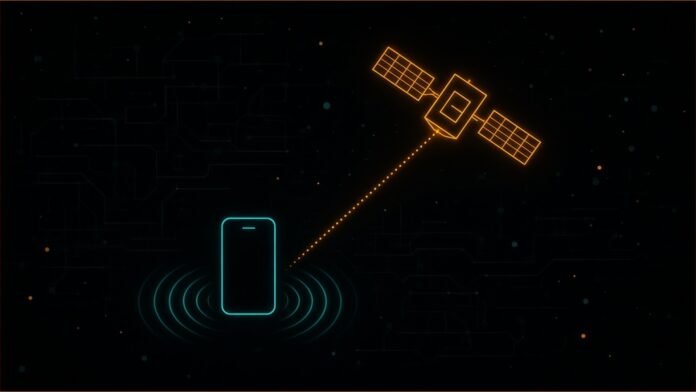
Vivo Satélite connects a compatible 4G or 5G phone directly to Starlink’s low-orbit satellites when the handset cannot find the operator’s terrestrial network. The phone shows the network as “VIVO STARLINK” while connected, and switches back automatically when a ground signal returns. Some models need the network selected by hand, Vivo says.
The list of supported services is short. Vivo names WhatsApp (messages and voice calls), SMS, MMS, RCS, Google Messages, iMessage, Google Maps, Apple Maps and its own app. Everything else is off. “Traditional network voice calls (SMP), video calls, access to external links and apps or services not expressly listed above will not be available,” the page says (TSN translation from Portuguese). Satellite use does not count against a plan’s data allowance.
To use it, customers need a compatible handset with an updated operating system, a 4G or 5G SIM or eSIM, and national data roaming switched on. Vivo warns that the signal is weaker inside vehicles and needs a clear view of the sky. The page also says the service “will soon” be usable abroad.
The service is not an emergency line
The most important caveat sits in the terms. “Calls to emergency services and the receipt of Civil Defence alerts are not supported while the device is connected to Vivo Satélite,” Vivo states (TSN translation). It also warns that “delays of a few minutes may occur because of the customer’s location, environmental conditions or the availability of the satellite network” (TSN translation).
Vivo still pitches the link as a resilience tool. “In situations of natural disasters or unavailability of terrestrial infrastructure, the service may help with communication through the compatible functions,” the page says, “subject to the technical limitations” (TSN translation). In practice, that means a stranded driver could message family on WhatsApp or share a location, but could not call emergency services over the satellite connection.
That gap is worth setting against the United States, where the Mystic Alerts Act has just opened the way for emergency alerts to reach phones by satellite, though rules are still to come.
Free until October 2027 on most plans
Vivo says customers on Vivo Pós, Vivo Total, Vivo Controle, Vivo Lite and Vivo Pré “can enjoy the benefit included in their plan free of charge, for a limited time” (TSN translation), and its plan cards read “free until Oct/27”. Specialist site Minha Operadora, citing the service terms, gives the free period as 26 October 2026 to 25 October 2027 for consumers and to 26 January 2027 for business lines. Pre-paid customers qualify through top-ups of R$30 or more, and Controle plans need a main data allowance of at least 10 GB, with some older plans excluded. Vivo has not said what the service will cost afterwards.
Minha Operadora also reports that the service runs under a limited private service licence in Anatel’s experimental regulatory environment, which means its regulatory form could change when that period ends.
Vivo framed the launch in national terms. “With Vivo Satélite, Vivo customers will have signal wherever they are: on highways, in rural and remote areas or in hard-to-reach regions not yet served by terrestrial infrastructure,” Alex Salgado, Vivo’s chief operating officer, said, according to Terra (TSN translation). Vivo says its ground network already covers 98% of Brazil’s territory.
Stephanie Bednarek, SpaceX’s vice-president of sales, told Terra that the agreement lets Starlink Mobile and Vivo “provide access to selected messaging apps and services for millions of people across Brazil and, in future, deliver high-speed data” (TSN translation).
Brazil now joins a growing list of Starlink Mobile operator markets. TSN reported last week that more than 11 million VEON customers have connected to Starlink Mobile at least once across Ukraine, Kazakhstan and Bangladesh, and that SpaceX is seeking 80,000 US cell sites for the service, after it agreed to buy mobile spectrum to support a next-generation network.
A free year makes Brazil a large test of satellite texting
Vivo has switched the service on automatically for eligible plans, according to Minha Operadora’s reading of the terms, and it costs nothing for a year. That removes the usual barrier to satellite-to-phone services, which is persuading people to pay for coverage they hope never to need. If Starlink’s figure of seven million connected phones holds, Brazil becomes one of the largest live populations for this kind of service almost overnight.
The design also sets clear limits on what users should expect. The app list is short, messages may take minutes, and the link cannot carry emergency calls or Civil Defence alerts. For hikers, truckers and riverside communities, that is still a large improvement on no signal at all. But it is a messaging fallback, and Vivo’s own terms say so. The risk is that users read launch claims of connectivity across 100% of Brazil as meaning they can call for help anywhere, when they can only send a message.
The commercial question comes later. Vivo has published no price for October 2027 onwards, and Starlink is promising high-speed mobile data from a future network rather than this one. The year of free use will show how many Brazilians rely on the link often enough to pay for it.
The first figure to watch is how many of those seven million phones actually send a message over the satellite link, and Vivo has not said whether it will report that.
Sources
- Vivo, “Vivo Satélite” product and terms page, accessed 26 October 2026
- Starlink (@Starlink), post on X, 26 October 2026
- Terra, “Vivo lança Vivo Satélite, em parceria com a Starlink, e terá conectividade em 100% do Brasil”, 26 October 2026
- Minha Operadora, Cristino Melo, “Vivo Satélite chega com Starlink e leva WhatsApp a áreas sem sinal no país”, 26 October 2026
Related stories
- 11 Million VEON Customers Have Used Starlink Mobile at Least Once
- SpaceX Seeks 80,000 US Cell Sites for Starlink Mobile, Bloomberg Says
- Space Roundup: SpaceX Agrees to Buy Mobile Spectrum, NASA Goes Nuclear and Amazon Leo Nears Launch
Follow @tsnmediahub on X for breaking AI news as it happens.
Follow on X